

Contents
There are three important things when writing Japanese, whether it be kana or kanji:
Stroke order
Every character has a set way of being written and the strokes have an order to them.
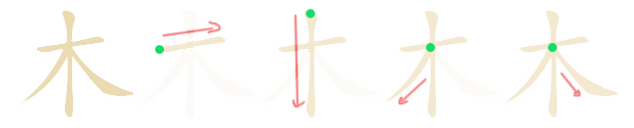
For example, when we write 木, we first write the horizontal stroke, then the vertical and then the left sweep and right sweep.
Try to follow this stroke order and memorise it. It might look arbitrary and daunting at first, but after the first few hundred kanji you will realise the pattern and be able to guess the stroke order of kanji you don't even know yet.
Is stroke order important? Yes, it is. It's the most efficient way of writing (even if it may not look like it to the untrained eye) and brings consistency to your writing. It becomes especially important when writing (and reading) in 行書 "semi-cursive" which relies on the right stroke order.
Character Balance
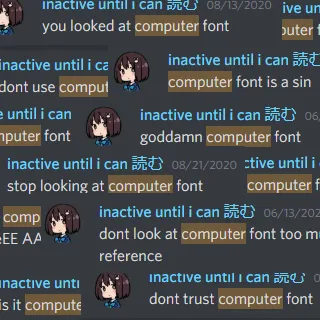
Do not copy computer fonts.
The characters you see on the screen look the way they do mostly because they are made to fit in a tiny block with a limited set of pixels.
However, this is not how we actually write the characters.
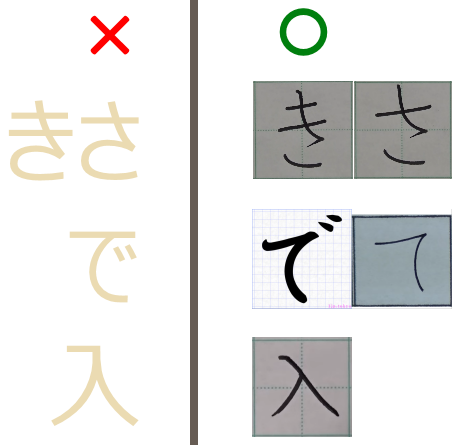
Some examples of this are:
- We don't connect き and さ
- We don't put the dakuten ( ゙) in the middle of a character like in で, but always at the top right
- We don't write 入 like... that
You can compare this to how we don't write a Times New Roman "g" when handwriting in English.

Proportions
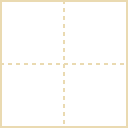
Proportions are also very important. In order to practice character balance and get used to it, it's highly advised you write each character in a box divided by a 4 section grid, like so: 田
You can then look up stroke order and proportions of each kanji on for example Jisho.org
You can download practice sheets or make them yourself. You can also just buy any grid notebook as long as the grid isn't too small and you can write a single character in 4 squares comfortably.
As a last resort you can also simply draw a grid yourself:
Types of strokes
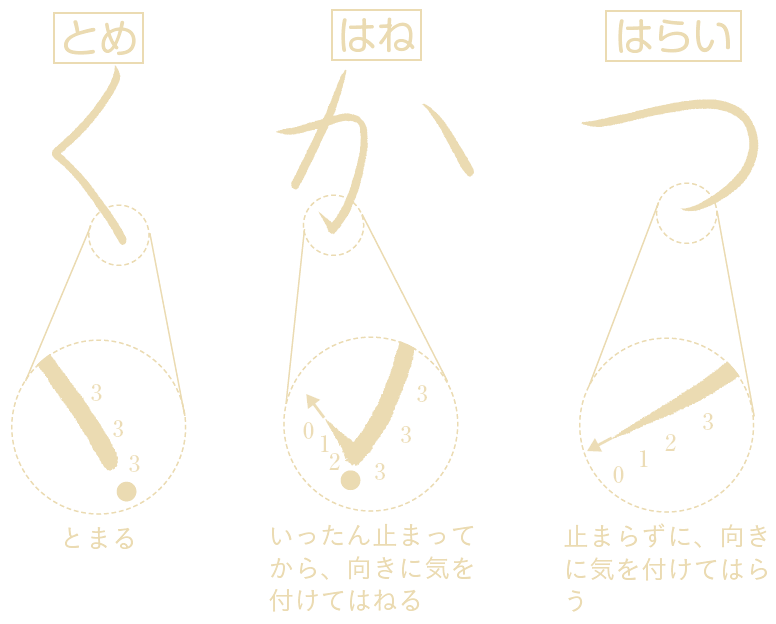
There are 3 basic types of stroke endings:
- とめ or "stop"
- はね or "jump" (or hook, flick, etc)
- はらい or "sweep" (or brush, etc)
These apply to kana as well as kanji, just like everything else that's written above. This image should explain the difference:
Where to start? Kana!
As for where to start, start with learning how to write hiragana and katakana properly. The YouTube channel Japanese Calligrapher Takumi is a great resource, following along with his videos on writing hiragana and katakana, paying very close attention to his proportions and how the strokes fall in relation to the guidelines. Balance is key.
Side note: wi ゐ and we ゑ
In both videos, Takumi doesn't include two kana that are often excluded from textbooks that you still should learn despite them not being in common use: wi (ゐ in hiragana, ヰ in katakana) and we (ゑ in hiragana, ヱ in katakana).
While they were both deemed obsolete in 1946 in a spelling reform, wi ゐ merged with i い and we ゑ merged with e え, they still come up and are useful to know. In addition to poetry, they also occassionally mostly in names:
- The author of the manga Nichijou 日常, Keiichi Arawi あらゐ けいいち, has wi ゐ in his name.
- The Touhou character Inaba Tewi 因幡 てゐ, also has wi ゐ in her name.
- The god Ebisu えびす is also sometimes written as Webisu ゑびす
In short: learn them, because of you don't, you're essentially situationally illiterate.
Hiragana
When you are done writing out the full hiragana chart, submit to the hiragana challenge (send -h submit hiragana along with a picture of your work to a participating handwriting channel) to get feedback.
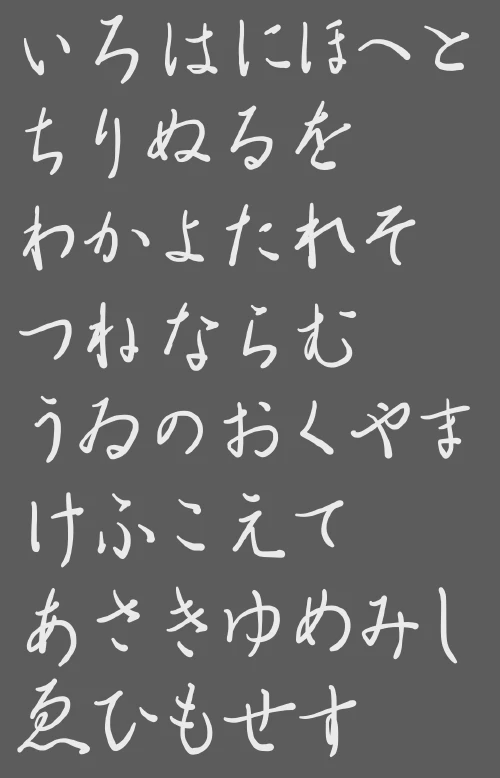

Iroha
If you're feeling bored just writing out hiragana in order, try writing out the Iroha いろは! It's a classical Japanese poem that's a pangram (contains every letter once, well, except n ん, which didn't really exist when it was written) — essentially the Japanese equivalent of "The quick brown fox jumps over the lazy dog." Of course, since it's classical Japanese it includes wi ゐ and we ゑ too.
Once you have written it, you can submit to Tegaki Tuesday #178 — いろは (send -h submit 178 along with a picture of your work to a participating handwriting channel) to get feedback. The first portion of the challenge is just the Iroha with kanji, if you want to only practice hiragana, feel free to skip it.
Katakana
When you are done writing out the full hiragana chart, submit to the katakana challenge (send -h submit katakana along with a picture of your work to a participating handwriting channel) to get feedback.